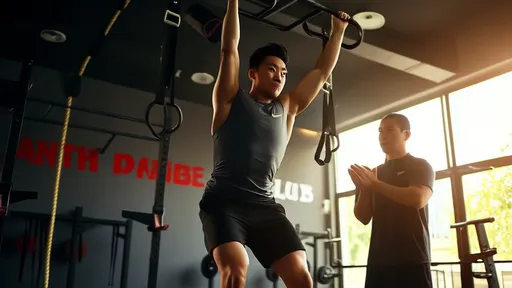
Breaking through the elusive first pull-up remains one of the most common and frustrating fitness milestones. Many enthusiasts spend months, even years, staring up at that bar, feeling the goal perpetually out of reach. The journey from zero to one is less about raw strength and more about a strategic, patient approach that builds the necessary musculature and neural pathways. This isn't a sprint; it's a meticulously crafted ladder of progression where each rung solidifies the foundation for the next.
The initial phase has nothing to do with the bar at all. It begins on the ground, mastering the art of the scapular pull. This deceptively simple movement is the bedrock of all vertical pulling strength. It involves simply hanging from the bar and retracting the shoulder blades down and back, without bending the elbows. This isolates and activates the latissimus dorsi, the very engine of the pull-up. Most beginners mistakenly try to pull with their arms, neglecting this critical back engagement. Spending time here, building the mind-muscle connection, is non-negotiable. It transforms a dead hang from a passive stretch into an active, preparatory position.
Once the scapular movement is second nature, the next logical step is introducing the eccentric, or negative, portion of the movement. The concentric phase (pulling yourself up) is significantly more challenging than the eccentric (lowering yourself down). We can leverage this. Using a box or a jump to get your chin over the bar, the goal is to lower yourself down with absolute control. The descent should be agonizingly slow, taking anywhere from three to ten seconds. This controlled resistance under load is brutally effective for building strength and tendon resilience. It teaches the body the precise path of movement under full bodyweight load, engraving the motor pattern without requiring the strength to initiate the pull just yet.
For many, the jump into a full negative is still too great a leap. This is where assisted variations create a crucial bridge. Band-assisted pull-ups are the most popular method for good reason. A large resistance loop band hooked over the bar provides a boost at the very bottom of the movement—the sticking point for most—making the ascent possible. The key is to use a band with just enough tension to allow for five to eight clean reps. As strength improves, moving to progressively thinner bands reduces the assistance until it is no longer needed. The caveat is to avoid becoming reliant on the band's bounce and to ensure the scapular initiation and full range of motion are maintained.
Another highly effective but often overlooked tool is the inverted row. Performed on a Smith machine, squat rack, or even a sturdy table, this horizontal pull develops the same core musculature—lats, rhomboids, biceps—in a more mechanically advantageous position. By adjusting the angle of the body, the intensity can be finely tuned. A more upright position is easier; a more horizontal position, approaching parallel to the ground, is drastically harder. This exercise allows for high-volume, quality reps that directly contribute to vertical pulling strength, all while being far more accessible than the pull-up itself.
Grip strength and endurance are silent killers of pull-up attempts. You cannot pull what you cannot hold. Simply spending more time in a dead hang, working up to sixty seconds or more, builds the foundational grip and forearm stamina required. Adding active hangs, where you engage the scapulae and slightly depress the shoulders, turns this into a strength-building exercise rather than a passive stretch. This directly carries over to the initial phase of the pull-up, ensuring your grip isn't the first link to fail in the chain.
Consistency and recovery are the unsung heroes of this entire process. The muscles involved are large and recover relatively quickly, but the tendons and ligaments in the elbows and shoulders need more time to adapt to the novel stresses of hanging and pulling. Training pull-up progressions every other day allows for this necessary adaptation. On off days, focusing on antagonist push movements like push-ups and overhead presses helps maintain muscular balance around the shoulder joint, preventing injury and promoting healthy joint function.
Nutrition and mindset form the final, critical pillar. Building strength is a process of breakdown and repair. Ensuring adequate protein intake provides the building blocks for muscle protein synthesis, while overall caloric energy fuels the workouts. Perhaps more important is the psychological shift: celebrating the small victories. The first five-second negative. The first full rep with the thickest band. The first time you feel your lats fire automatically. These are all the real reps. The single unassisted pull-up is merely the ceremony at the end; the true work is done in these incremental gains.
There is no single magic bullet for achieving that first pull-up. It is the culmination of a holistic approach that combines strategic exercise selection, patience with progression, attention to recovery, and unwavering consistency. By respecting the process and dedicating time to master each step of the ladder—from the scapular pull and dead hangs to negatives and assisted variations—the bar that once represented a barrier transforms into a tool of achievement. The journey from zero to one is a masterclass in discipline, proving that the greatest strength built isn't always in the muscles, but in the resolve to show up and put in the work, day after day.

By /Aug 25, 2025

By /Aug 25, 2025

By /Aug 25, 2025

By /Aug 25, 2025

By /Aug 25, 2025

By /Aug 25, 2025

By /Aug 25, 2025
By /Aug 25, 2025

By /Aug 25, 2025

By /Aug 25, 2025

By /Aug 25, 2025

By /Aug 25, 2025
By /Aug 25, 2025

By /Aug 25, 2025
By /Aug 25, 2025

By /Aug 25, 2025
By /Aug 25, 2025
By /Aug 25, 2025

By /Aug 25, 2025

By /Aug 25, 2025
